

Inside the Push to Redesign Nursing From the Bedside Up: An Interview with Caroline Mascarenhas, DNP, RN, NEA-BC
 Among the hundreds of decisions a bedside nurse must make over the course of their shift, each one carries a trail of details to track and revisit.
By mid-shift, mental notes begin to stack: Who hasn’t eaten, which labs require follow-up, where in the chart was that one progress note? Holding all of that at once, called cognitive overload, is often due to alarms, electronic health records, and technology-mediated communication, as one 2020 study published by Nurse Leader points out.
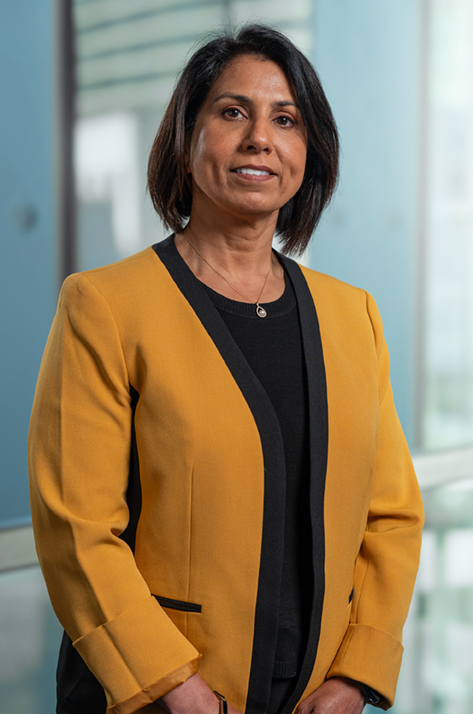
At Houston Methodist, that strain has been the starting point for redesign. At its center is Caroline Mascarenhas, DNP, RN, NEA-BC, the Vice President and Chief Nursing Officer at Houston Methodist Cypress Hospital, built with the goal of testing how technology can support nursing practice rather than adding to the cognitive burden.
Innovation on the Unit
Houston Methodist Cypress was designed to have infrastructure to support multiple layers of innovation, spanning virtual nursing to wearable technology to predictive analytics.
“As we explored innovation, we see that there's no single solution for everything. It’s multi-factorial, with multiple solutions, platforms, and vendors, and we have to figure out how they all connect,” Mascarenhas explains.
Rather than testing and implementing each solution separately, the focus is on how these innovations can work in harmony with one another and within the science of nursing. There is no defined endpoint, Mascarenhas admits. The work is ongoing, in a constant cycle of assessment, development, evaluation, and iteration, carried out in partnership with the nursing workforce. That way, nurses are not only the end users of technology, but the co-creators.
New Grad to Nursing Leader
Mascarenhas traces her nursing leadership DNA back to her time as a new grad.
We learn to advocate for our patients in nursing school, she asserts, but then you also extrapolate that principle to other types of advocacy: advocating for your work environment, your team, or professionalism in the field of nursing. “That advocacy sparked my interest early on. When you get promoted from bedside to charge nurse, it shifts your advocacy from patients to advocating for resources and the work environment. And that got me very, very interested in pursuing leadership in nursing.”
From there, Mascarenhas took all the opportunities she could for both linear promotions and experimental learning. She moved from charge nurse to manager to director, to vice president, and eventually chief nursing officer.
Mascarenhas boils down her leadership run to a few key lessons:
-
Curiosity. “You always have to have a curious mind around. How can I do this better? What do I need to have in my toolbox to to do things differently?”
-
Financial acumen. “How do you balance that clinical need of your profession with a financial need of the profession as well?”
-
Participation in ‘nursing extra-curriculars’. “I sought out opportunities. I always raised my hand if someone needed a nurse on a committee.”
-
Additional education. “I pursued and got a master's and got my doctorate. Certifications are another aspect of validating your practice, so I am certified as well in executive leadership.”
-
Finding your spark. “I get joy from operations, and so I figured that's where I wanted to go.”
As an executive, her leadership philosophy is to bring the frontline nurses up into innovative decision-making. “My role is to balance the fiscal needs of the innovation with the operational needs of the innovation. It's my frontline nurses who are going to be participating and partaking in the use of the innovation, and the outcomes are going to be driven by that use. And so the people at the bedside are the ones who need to be giving direct input.”
Built Around Bedside
To support innovation, Mascarenhas makes sure there is somewhere for ideas to germinate.
"You need a structure in place for that," Mascarenhas urges.
Houston Methodist Cypress has a daily huddle for frontline staff to brainstorm ideas, and leadership writes those down. They're called idea tickets, which get collected and reviewed by the leaders of each department every day. From there, someone asks how the ideas can be translated into an innovation. Instead of labeling these ideas as complaints, leadership probes the frontline staff: What are you frustrated with? What’s broken? “Thousands of ideas can come up, and it creates the environment of people questioning why we do things a certain way, and how we can make it easier.
Sometimes they are quick fixes, Mascarenhas explains. One of the nurses asked for a binder to be put in place, and Mascarenhas approved and implemented it quickly. Other solutions take a bit more time, like equipment that keeps going missing and requires a process to locate it.
Ambient AI
This open communication and leadership style is carried throughout other innovations at the hospital, including a pilot with ambient artificial intelligence documentation.
Right now, six nurses are very active in the pilot process, capturing measurable outcomes and providing feedback. For example, in this pilot, the nurses noticed that certain assessment data was not captured correctly through the ambient AI. “Rather than training the nurses to say something in a different way so the ambient AI picks it up, we are making sure the technology changes to support how the nurses speak naturally.”
Along with ambient AI, nurses also receive summaries of notes. Rather than having to go through each nutrition note, nurses receive a summary at the start of their shift saying that the patient has been there for two days and has only eaten 20% of all their meals. “Now, they quickly know they need to talk to the nutritionist and physician, and that summary gave them their time back.”
BioButtons
Cypress has implemented a wearable technology called a BioButton that tracks basic vital signs. This technology allows nurses to capture vital signs more often, as well as additional data, like activity, sleep, and body position. Data trends from this technology help nurses spot patterns in patient decline, as well as monitor patients who have chronic diseases, such as congestive heart failure.
Virtual Nurses
In addition to products and technology, Mascarenhas is also leading workforce innovation. Houston Methodist Cypress has implemented virtual nursing, an additional staffing layer where a licensed nurse provides remote support for bedside nurses.
“I never see a virtual nurse being an avatar,” Mascarenhas says. “A virtual nurse will still be a human. When my nurses ask if they will ever be replaced by an avatar or a robot, I say never. Healthcare is such a combination of critical thinking from a human aspect, and compassion has to be part of our everyday interactions with patients. It’s a collective partnership.”
Virtual nursing programs most often support bedside nurses through documenting admissions and discharges, providing remote patient monitoring or sitting, or alerting the bedside nurse of overdue tasks.
Reimagining Time on the Frontlines
With so much innovation taking place at the bedside right now, the question many might ask is: Given all the support bedside nurses are going to get, how will that extra time get re-allocated?
“There’s no such thing as extra time,” Mascarenhas explains. “I look at it as meaningful time.”
This shift reframes the problem of cognitive burden on frontline staff, because although that mental checklist doesn’t disappear entirely, it can become more succinct and clear. Instead of frantically scanning for potentially missed details, nurses can act on what matters sooner.
That time becomes more meaningful when, instead of spending so much time on charting, the nurse can spend time teaching a patient about how to take their cardiovascular medications. Rather than removing work, the goal is to reduce the risk of something getting overlooked so nurses never clock out worrying: Did I miss something today?
If cognitive burden is the problem modern healthcare systems were not designed to accommodate, this approach to innovation begins to address it by reinforcing nursing judgment rather than replacing it.
________________________________________
Resources
- Principles of Virtual Nursing
- The Ethical Use of Artificial Intelligence in Nursing Practice
- See You Now Podcast Episode 130: AI in Play: The Clinicians Shaping Healthcare Technology Part I